What Missouri Quarries Mean by Base Rock and the MoDOT Types
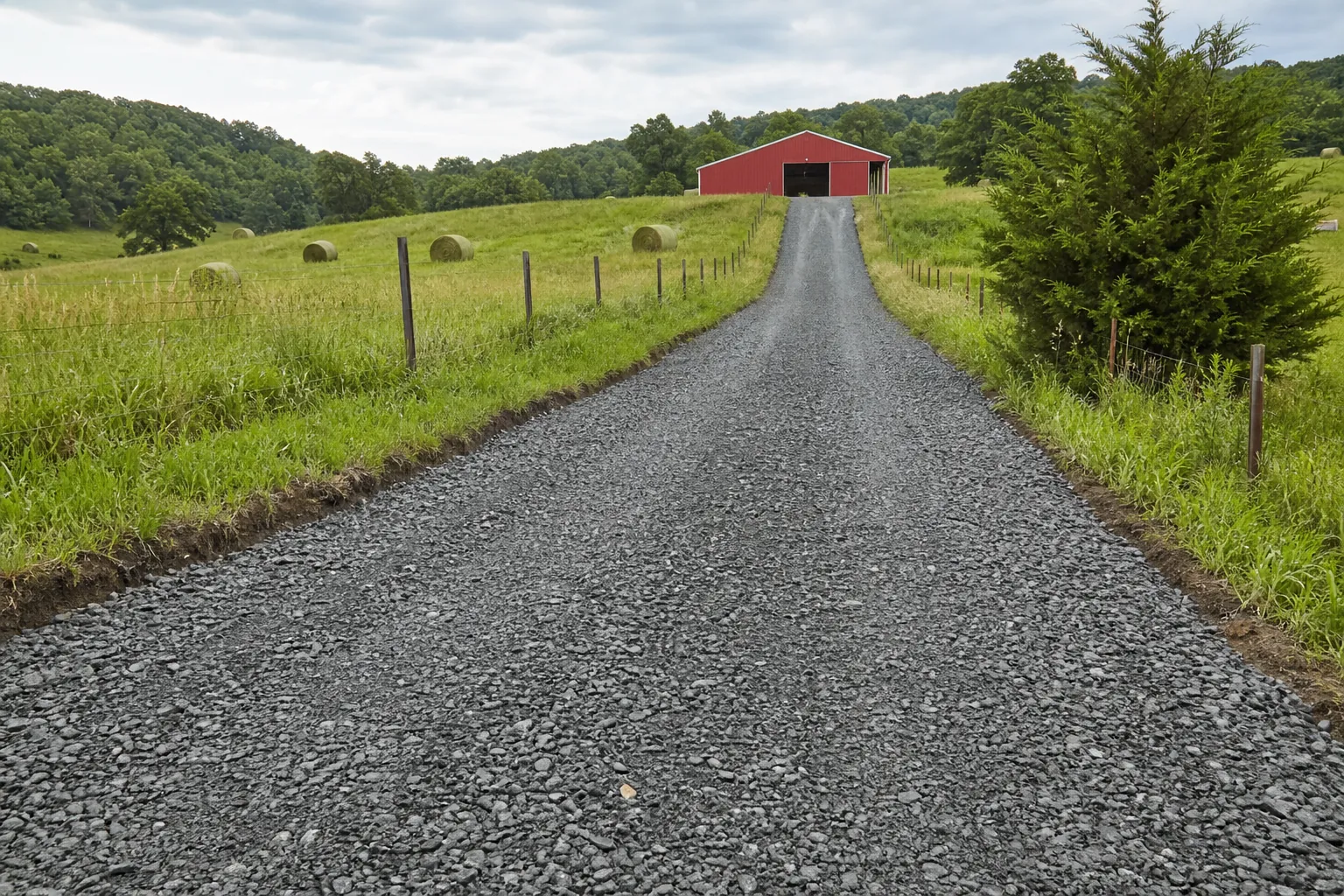
The contractor said Type 5. The ticket from the last job said base rock. Now there is an order form in front of you and the question is whether those are the same thing. They overlap a lot, but they are not the same promise, and the difference matters when the stone is going under a drive, a shed pad or a farm lane.
Base rock: the Missouri name
Base rock is the everyday Missouri name for crushed stone mixed with its own fines, laid under something and compacted. A central Missouri quarry group lists its base products by MoDOT type and describes them as material that stabilizes the subgrade under asphalt and concrete paving, builds parking lots and highways, and compacts into a hard, sealed surface. That last part is the whole idea. A load of base rock runs from pieces near the top size down to dust, and the small stuff fills the gaps between the big stuff.
Type 1, Type 5 and Type 7 are narrower terms. They come from the Missouri Department of Transportation, and each one is a gradation with numbers attached.
What MoDOT Section 1007 says about the three types
Section 1007 of MoDOT's highway construction specifications covers aggregate for base. The figures below come from a 2017 copy of that section, and MoDOT revises its spec book, so check the current edition before a job depends on them. For all three types it allows crushed stone, sand and gravel, or reclaimed asphalt or concrete. All three cap deleterious rock and shale at 15 percent, and all three hold the plasticity index of the fraction passing the No. 40 sieve to six or less. The gradations, in percent passing by weight, are where they part ways:
Sieve | Type 1 | Type 5 | Type 7 |
1-1/2 inch | 100 | ||
1 inch | 100 | 100 | 70-100 |
1/2 inch | 60-90 | 60-90 | |
No. 4 | 35-60 | 35-60 | |
No. 8 | 15-50 | ||
No. 30 | 10-35 | 10-35 | |
No. 200 | no limit listed | 0-15 | 0-12 |
Read it from the top. Type 1 and Type 5 are both 1 inch materials with the same band all the way down to the No. 30 sieve. The only difference is the last line: Type 5 holds the dust passing the No. 200 sieve to 15 percent or less, and Type 1 lists no limit there. Type 7 is the coarse member. Everything passes a 1-1/2 inch screen, and up to 30 percent of it can stay on a 1 inch screen.
On a state job those numbers get checked. MoDOT's Engineering Policy Guide article on aggregate for base lays out the testing: sieve analysis, plasticity index, deleterious content, Los Angeles abrasion, and a maximum density and optimum moisture run by the central lab. That is what a type is. It describes how material is specified and accepted here. It is not a stamp that rides along with a load of rock to your property, so if a plan sheet or a road district names a type, ask for the gradation of what you are buying and hold it against the table.
What the fines do
Fines are the reason base rock packs and clean rock does not. Under a roller or a loaded tire, the fine particles fill the voids between the larger stones and lock them in place. Too few fines and the layer stays loose. Too many, or fines that turn greasy when wet, and the layer goes soft in a wet March. MoDOT limits how plastic those fines are allowed to be.
MoDOT's construction guidance for aggregate base courses says aggregate bases provide additional structure and drainage, and it calls Type 5 base intended to provide drainage. The same guidance says Type 5 must not be segregated, and that base material needs enough moisture while it is placed to keep segregation down. Segregation means the coarse stone and the fines separate, leaving loose, stony patches beside dusty ones instead of one locked layer. Keep the material damp while it is spread.
The Federal Highway Administration's Gravel Roads Construction and Maintenance Guide makes a related point from the surface side. Base gravel generally has a larger top size and a very small share of fine material, for strength and drainage. Used as the driving surface, the guide says, it will not form a crust that holds it together. Base rock is built to sit under something.
Base rock vs clean rock
Around here, clean rock means washed stone with the fines taken out. The #57 limestone sold as 1 inch clean is the common example: washed, angular, 3/16 inch to 1 inch, with nothing between the pieces. Water runs straight through it. That is exactly what you want in a French drain and exactly what you do not want as the only layer under a drive, because with nothing to bind it, clean stone stays loose, rolls under a tire and drifts toward the edges.
So the two do opposite jobs. Base rock carries load as one dense layer. Clean rock moves water through open voids.
When a coarser grade helps
Section 1007 does not say where each type goes. The plans for each job do. Outside state work, the names get looser: a quarry near Branson lists base material by top size, 1 inch, 1-1/2 inch or 2 inch, rather than by MoDOT type. If a ticket only says base, ask which top size is in it.
On most house drives and shed pads, though, a coarser grade is not where the problem gets solved. A lane that ruts on wet clay has a subgrade problem. The FHWA guide offers two fixes for a weak, wet subgrade. Either the soft soil is excavated and backfilled with clean material that drains, or the same excavation gets a geotextile over its floor before the backfill, which stops fine wet soil from pumping up into the new stone. Only then does a compacted base course have something firm to push against. On cherty Ozark ground that is firm once you scrape down to it, you may need neither.
Going the other way, a pad or apron that needs a close, smooth finish is a job for crusher run, 3/4 inch minus stone blended with its own dust. It packs tighter and screeds flatter.
Ordering base rock
The base rock sold here is described as crushed stone and gravel, graded through a range of sizes and bound with fines. If your job has a specification behind it, check the gradation against the type before you order.
Depth is a ground question first. For cars and light trucks on ground that drains, this site's ordering FAQ puts the compacted course at around four inches. A loaded grain truck, a tandem or a full hay trailer needs noticeably more, and ground that holds water from November into April needs its drainage fixed before any depth will help. However thick the course, build it in lifts. In its construction guidelines, the FHWA guide keeps loose layers to generally no more than 4 inches, allows "layers up to 8 inches" where larger compaction equipment is available, and wants water worked in until the stone is at the moisture content for maximum density. MoDOT's base course guidance has each layer compacted before the next goes on, and no base placed on frozen subgrade.
For tonnage, the road base calculator uses about 1.50 tons per cubic yard and adds 10 percent by default for compaction and spillage. A lane 12 feet wide and 80 feet long at 4 inches is 320 cubic feet, or 11.85 cubic yards. That is about 17.8 tons before the allowance and about 19.6 tons with it.
The load comes off as one pile. The delivery checklist asks for a route about 12 feet wide with no low branches or wires and a firm, level spot to tip, so pick a drop point where the spreading can run downhill from the pile.
If a plan names a type, match the gradation. If nobody names one, the questions that decide the order are how firm the subgrade is, where the water goes and how heavy the traffic will be. Those set the depth. The label on the ticket does not.