Crusher Run Calculator: Work From the Compacted Depth
Enter your project dimensions
Most of the crusher run figured on this page goes under a rural drive, a shed pad or the flare where a lane meets a county road, and most of the orders that finish short go wrong in the same place. Loose material tightens by roughly 10 to 15 percent once a plate compactor has been over it, so a lane placed at a loose four inches settles nearer three and a half. Every depth quoted below is the finished depth after compaction. Put that figure into the crusher run calculator and round the tonnage up, not down.
Where a Farm Lane Order Comes Up Short
A short order is almost never bad arithmetic. It is a measurement taken somewhere other than where the rock goes.
- The lane was measured on a plan rather than on the ground. A lane climbing out of a hollow covers more surface than its map length. Run the tape along the ground you walk on.
- The apron at the road was left out. The flare where a lane meets a county road is often half again the width of the lane. Enter it as a second area.
- One width was used for a lane that has spread. Gravel lanes widen at the bends and at the turnaround. Take three or four widths and average them before typing anything in.
- A soft stretch was averaged in with firm ground. Where water perches on northern claypan through late winter, that section wants its own depth. Run it as its own area rather than deepening the whole lane.
Orders come out long for one reason worth naming: the base course and the surfacing course get entered as a single thick layer at one weight. They are two orders. Figure the compacting layer here and the surface rock separately.
Putting a Compacted Depth Into the Crusher Run Calculator
The form takes a rectangle, a circle, or up to five areas added together, which is what a lane plus an apron plus a turnaround needs. Length, width and diameter go in as feet. Depth goes in as inches and accepts anything from 0.25 to 24. Choose the material, and keep the box that adds 10 percent for compaction and spillage ticked, as it is by default, if the subgrade is rough or the pile has to be wheelbarrowed any distance. Pressing calculate returns cubic yards, tons and cubic feet at once, and the email option sends the figures on rather than making you write them down.
Depths worth entering, all measured after compaction: 4 inches under a path or a paver assembly, 4 to 6 inches under a car drive, 6 to 8 inches where a loaded truck or a tractor turns, and 6 rather than 4 on soft or clay subgrade. Build the depth up in lifts of about 2 inches and compact each one. Two thin passes hold a grade far longer than a single thick placement, and damp material locks together better than dry.
Crusher Run at 3,000 Pounds to the Yard
The volume is straightforward: cubic yards equal length in feet times width in feet times depth in inches divided by 12, all divided by 27. Tons are those yards multiplied by what the material weighs.
| Material | Pounds per cubic yard | Tons per cubic yard |
|---|---|---|
| Crusher run and base rock | ~3,000 | 1.50 |
| Screenings | ~2,900 | 1.45 |
| #4 stone and railroad ballast | ~2,900 | 1.45 |
| 1 inch clean and 3/4 inch clean | ~2,800 | 1.40 |
Fines are why crusher run sits at the top of that list. They pack into the gaps between the stone, so the same volume weighs more than washed rock of the same size. Tons are what you order. The cubic yard figure tells you how much room the pile takes on the ground before you start spreading.
Coverage follows from the same numbers. One ton at a compacted 4 inches covers about 54 square feet, at 6 inches about 36, and at 8 inches about 27. A cubic yard covers roughly one and a half times those areas.
Crusher Run, Base Rock and Clean Rock Are Three Separate Orders
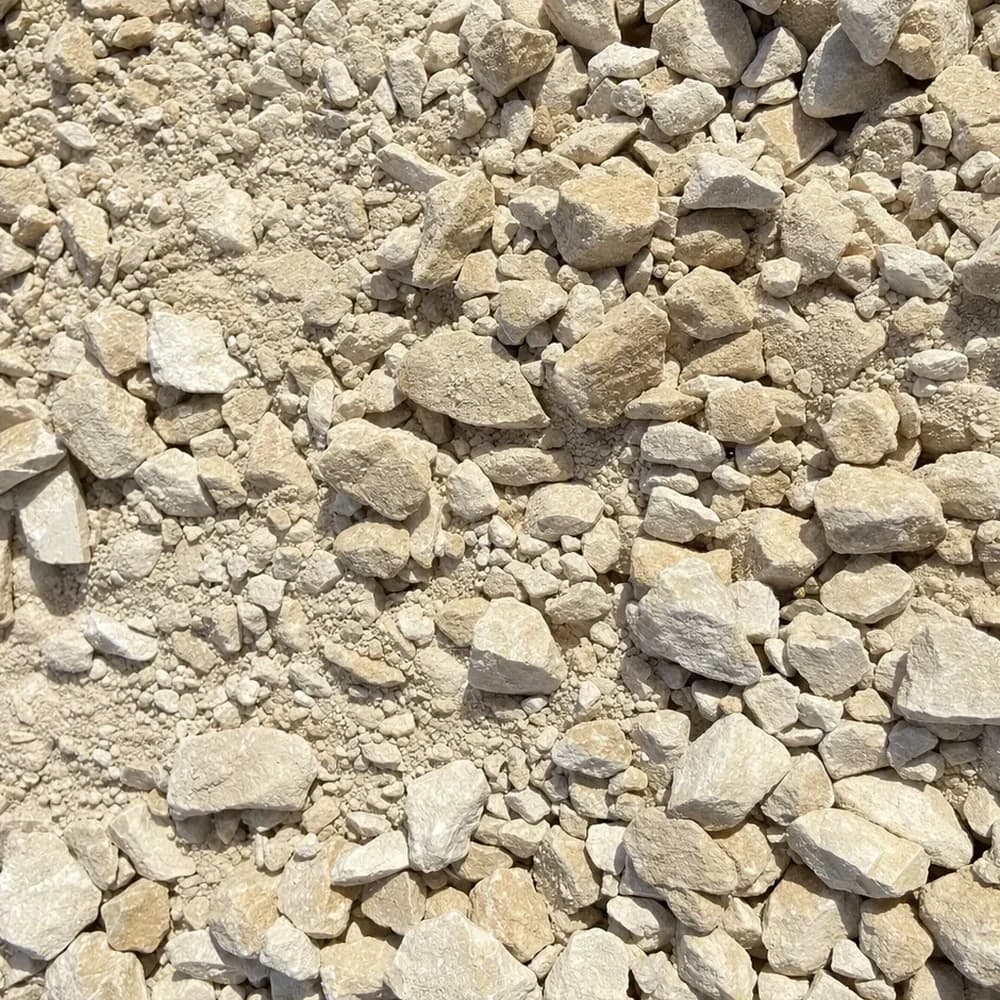
Crusher run is what comes off the crusher with its fines still in it. Base rock is the Missouri name for the dense-graded material MoDOT specifies for base as Type 1 or Type 5, both 1 inch mixes of crushed stone and fines, with Type 5 also capping the finest dust; Type 7 is the coarser 1-1/2 inch grade. Those are the terms a local ticket uses, not a certification anything here holds. Both products carry fines and both are figured at 1.50 tons to the yard, so the tonnage comes out the same. The choice is which product page you order from: crusher run or base rock.
Clean rock is the third term and it swaps for neither. In Missouri clean rock means washed stone with no fines at all, usually 1 inch clean, and its job is drainage. Keep crusher run out of a French drain or a wet trench for that reason: the fines that make it a good base also hold water. Use the stone calculator for washed sizes, the base rock calculator when the order is base rock, and the paver base calculator when the layer sits under pavers and you also need the excavation depth.
A Lane Approach, a Shed Pad and a Turnaround
These are worked examples with invented dimensions, not customer jobs.
The approach off the county road. A 12 by 55 ft strip at 5 inches compacted.
- 12 x 55 = 660 sq ft
- 660 x 5 / 12 = 275 cu ft, which is 275 / 27 = 10.19 yd3
- 10.19 x 1.50 = 15.3 tons, or 16.8 tons with the 10 percent box ticked
A shed pad on stripped ground. A 14 by 16 ft pad at 4 inches.
- 224 sq ft x 4 / 12 = 74.67 cu ft, which is 2.77 yd3, or 4.2 tons
- On soft ground the same pad at 6 inches takes 112 cu ft, 4.15 yd3 and 6.2 tons
A turnaround at the top of the drive. A circle 26 ft across at 6 inches, entered in circle mode as a 26 ft diameter.
- The area is about 531 sq ft, so 531 x 0.5 = 266 cu ft
- 266 / 27 = 9.85 yd3, which is 14.8 tons, or 16.3 with the allowance
Dropping the Load Where You Mean to Spread It
Once the tonnage is settled, open the product page, set the quantity and choose a delivery date there. Delivery is arranged at checkout by ZIP code, and the driver needs a firm surface and a clear path to the dump spot, which is the part worth thinking about on a steep lane or after a wet spell. Ask for the pile at the far end of the work so the material moves downhill and towards you. If a lane or a pad has you second-guessing the depth, Missouri Rock Supply takes questions through the contact page.
Common questions
Does the 10 percent box cover compaction?
Not on its own. The box adds a small margin for spillage and for an uneven subgrade. Compaction tightening is a bigger effect, around 10 to 15 percent, and the way to allow for it is to enter the finished compacted depth rather than the loose thickness, then round the tonnage up to the next half ton.
The lane climbs a bank. Do I use the horizontal distance or the sloped distance?
The sloped one, measured with the tape lying on the ground. The rock covers the surface, not its shadow on a plan. A steep pull also tends to wash at the bottom, so it is reasonable to enter the lower stretch as its own area at an inch or two more depth.
My parking area wraps around the shop in an L. How do I enter it?
Choose multiple areas and split it at the inside corner so the two rectangles never cover the same ground. A 14 by 30 ft leg and a 12 by 18 ft leg at 6 inches compacted come to 636 sq ft, 318 cu ft, 11.78 yd3 and about 17.7 tons.
Should the shoulder be in my measurement?
Yes, if rock is going on it. Crusher run placed to the exact edge of a lane loses material off both sides in the first season, so it is common to add 6 inches to each side of the width before calculating and let the shoulder take it.
How do I split one delivery between the base layer and the top layer?
Run the calculation twice. Figure the compacting course here at its compacted depth, then figure 2 to 3 inches of surfacing rock from the driveway gravel family at 1.40 tons to the yard, and put both quantities on the same order so the lane can be built in one go.
Related calculators
Base tonnage sorted? Good.
Crusher run by the ton, the cheapest structure on the yard, delivered free.