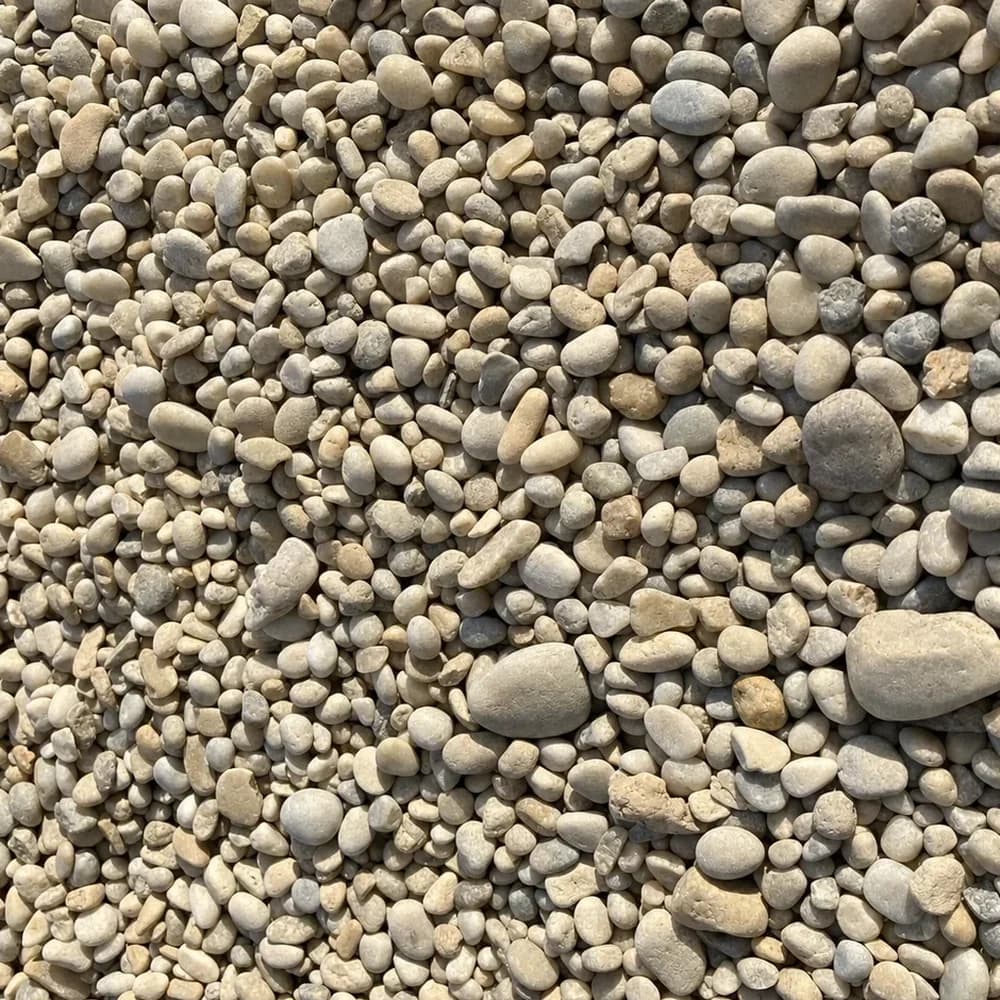
Pea Gravel Calculator: Get the Depth Right First
Enter your project dimensions
The order the pea gravel calculator most often has to correct is a depth borrowed from the wrong job. Rounded 3/8 inch stone laid two inches deep is a path you can walk barefoot on; the same stone under a swing set has to be nine to twelve inches deep to do anything at all, and that is six times the tonnage over the same square footage. Missouri ground adds a second question before you get to either: this is a state of slopes, hollows and thunderstorms that drop an inch of rain in an hour, and round stone travels. Sort out the depth and the edge first, then let the arithmetic follow.
Where Round Stone Stays Put and Where It Runs
Pea gravel is rounded, which is exactly why it is comfortable underfoot and exactly why it will not lock together. On flat ground with a rigid border it behaves. Above roughly a 5 percent grade, rain and foot traffic will work it downhill anyway, and on the steeper Ozark slopes it ends up in a fan at the bottom of the path by the second summer. Two ways round that: bed the gravel on a honeycomb stabilizing grid, or use angular walkway gravel on the sloped stretch and keep the round stone for the flat landing.
Edging is not decoration on this material. Set steel, aluminum, timber or paver edging so it stands about an inch above the finished gravel. Flush edging is the same as no edging: the stone rides over it within a season. On heavy clay that stays wet from late fall into spring, put the gravel over a compacted subgrade rather than straight onto soft ground, or it will press in and disappear.
Two Inches to Walk On, Nine to Twelve to Fall On
- Paths and walkways. 2 to 3 inches. Below 2 the ground shows through; above 3 it feels loose to walk on.
- Patio and seating areas. Put 2 inches of compacted screenings down first so chair legs have something to bear on, then 2 to 3 inches of pea gravel over it.
- Fire pit surrounds. 3 inches. The stone does not burn and rain drains straight through it, so the seating is usable the morning after a storm.
- Dog runs. 2 to 3 inches. Round stone is easy on paws and hoses clean.
- Playground fall zones. 9 to 12 inches, maintained at that depth. Follow the depth in the equipment manual rather than the one here. And note what the tonnage buys: this is landscape pea gravel, not certified playground surfacing. The required depth, the fall-zone footprint and the maintained depth all come from the equipment manufacturer's instructions rather than from us.
Entering a Path and a Fire Pit Circle in the Pea Gravel Calculator
The form takes a rectangle, a circle, or up to five areas totaled together, which is what a path running to a round fire pit landing needs. Length, width and diameter go in as feet, depth in inches from 0.25 to 24. Choose the material, use the optional 5 percent box for compaction and spillage, and press calculate for cubic yards, tons and cubic feet at once. The figures can be emailed rather than copied down.
Two habits worth having. Enter each piece at its own depth rather than averaging a 3 inch path with a 12 inch fall zone, because the averaged answer is wrong for both. And where something sits inside the area, such as the fire ring itself, run the area whole, run the obstacle as a second calculation and subtract.
2,800 Pounds a Yard, the Same as Crushed Stone
Cubic yards are area in square feet times depth in inches divided by 12, all divided by 27. Tons are those yards times 1.40 for pea gravel.
| Depth | One cubic yard covers | One ton covers |
|---|---|---|
| 2 inches | 162 sq ft | about 116 sq ft |
| 3 inches | 108 sq ft | about 77 sq ft |
| 4 inches | 81 sq ft | about 58 sq ft |
| 12 inches, fall zone | 27 sq ft | about 19 sq ft |
Rounded stone packs closer than people expect, so a yard of it weighs about what a yard of crushed stone does. That last row is the one to look at twice. At a foot deep, a ton covers a square roughly 4 ft 4 in on a side, which is why a play area is a delivery rather than a car boot full of bags.
A Dog Run, a Fire Pit Ring and a Fall Zone
Worked examples with invented dimensions, not customer jobs.
Dog run beside the shop. 10 by 22 ft at 3 inches.
- 220 sq ft x 3 / 12 = 55 cu ft
- 55 / 27 = 2.04 yd3, which at 1.40 is 2.85 tons. Order 3 tons.
Fire pit surround. A 10 ft circle with a 3 ft ring in the middle, at 3 inches.
- The circle is about 78.5 sq ft and the ring about 7.1, leaving 71.4 sq ft
- 71.4 x 3 / 12 = 17.9 cu ft, which is 0.66 yd3 and 0.93 tons. Order 1 ton.
Fall zone under a play frame. 18 by 15 ft at 12 inches.
- 270 sq ft x 12 / 12 = 270 cu ft
- 270 / 27 = 10.0 yd3, which is 14.0 tons
Half a Ton Over, and a Bucket Kept Back
Round up to the next half ton. Pea gravel finds every dip in a subgrade, and paths thin out along the line people actually walk, so a bucket or two set aside beats reordering next spring. Rake a path level twice a year and the layer lasts a great deal longer.
Where the stone changes, so does the calculator. 3/8" Natural Pea Gravel is what this page assumes. Larger decorative stone for beds and dry creek runs is figured on the river rock calculator at a lighter 2,700 lb per yard, and a drive, pad or oddly shaped area is easier on the gravel calculator. Once the tonnage is set, choose a quantity and delivery date on the product page. Delivery is arranged at checkout by ZIP code and the truck needs clear access to the dump spot, so pick somewhere the wheelbarrow run is short and downhill. If the depth or the edge is the part you are unsure about, the contact page is the place to ask before the order goes in.
Common questions
River rock and pea gravel over the same path, same depth. Why is the tonnage different?
They weigh different amounts per yard. A 3 by 30 ft path at 3 inches is 22.5 cubic feet, or 0.83 cubic yards, either way. As pea gravel at 1.40 that is 1.17 tons; as river rock at 1.35 it is 1.13. Volume comes from the path, weight comes from the stone.
Is the 5 percent box worth ticking for rounded stone?
It is fair cover for spillage and for a subgrade with dips in it, though pea gravel does not compact the way a base material does, so do not expect the box to make up for a thin depth. If the number lands just under a half ton, take the half ton.
The path drops down a bank to the creek. What do I enter?
Run the tape along the ground for the length, since the sloped surface is bigger than its footprint. Then reconsider the material for that stretch: above about a 5 percent grade, angular crushed stone stays where it is put and round stone does not.
Can I put the patio and the path in one calculation?
Yes, under multiple areas, as long as each piece carries its own depth and the pieces do not overlap. A 12 by 12 ft seating area at 3 inches plus a 3 by 26 ft path at 2 inches is 36 cu ft plus 13 cu ft, which is 1.81 yd3 and 2.54 tons.
The steel border stands an inch proud. Where does my measurement stop?
The inside face, because that is where the gravel stops. Remember the edging is meant to stand about an inch proud of the finished surface, so the stone fills to just below its top rather than level with it.
Related calculators
Under two tons covers most patios.
3/8 inch natural pea gravel, priced by the ton, delivered free.