Dirt Calculator: Sizing Fill for Missouri Low Ground
Enter your project dimensions
The order this page most often has to correct is the one placed for the hole as it looks today. Ground that sits low in Missouri is usually low for a reason: water perched on a claypan subsoil all winter and took the surface down with it, a spring storm cut a rill across a graded slope, or silt settled out of a river bottom. Fill placed in that hole consolidates by roughly 10 to 15 percent, so the dirt calculator gives you the volume of the void and the job gives you a little more than that. Work out the void first, then decide what to add.
What the Ground Under the Hole Does to the Depth
Northern claypan and till. Water perches above the dense subsoil from late fall into spring, and fill placed into a wet hole smears rather than consolidates. The volume you need does not change, but the working window does: late spring into fall is when the lifts will actually compact.
Rocky Ozark ground. Chert and rock make a low spot shallower than it looks, because the bottom of the dip is often rock rather than soil. Probe before measuring, or the depth you type in will be an inch or two generous.
Loess on the river hills. Loess washes easily, so gullies on bare slopes reopen where runoff still concentrates. Filling one without fixing where the water lands buys a season.
Bootheel and river-bottom silt. Flat, slow-draining ground holds standing water for long stretches, so fill there wants time and compaction in thin layers more than it wants extra depth.
Frost depth across the state runs roughly 24 to 36 inches depending on the local code, deeper north and around Kansas City than in the southern Ozarks. That governs footings, not a fill order, and nothing here is a substitute for an engineered specification where fill will carry a slab or a footing.
Measuring a Hole, Not a Surface, in the Dirt Calculator
Most calculators on this site measure a layer laid over ground. This one measures a space that has to be filled, which is the reason the depth field so often gets an honest guess rather than a measurement.
For a dip or a low lawn, measure the length and width across the whole area, then take the depth at the deepest point and at the shallow edge and use the midpoint of the two. For a trench or a square hole, the length, width and depth are the trench itself. For an irregular washout, split it into two or three rectangles under multiple areas, each with its own average depth, up to five in one calculation.
The form takes a rectangle, a circle, or those multiple areas. Length, width and diameter go in as feet, depth in inches, anywhere from 0.25 to 24. Pick the material, leave the 10 percent for compaction and spillage ticked or untick it, and calculate for cubic yards, tons and cubic feet. A hole deeper than 24 inches will not go in as one depth, so enter it as two passes and add the results: a 30 inch trench is a 24 inch run plus a 6 inch run over the same footprint.
Fill Dirt at 2,400 Pounds Dry, Nearer 3,000 Wet
Cubic yards are length in feet times width in feet times depth in inches divided by 12, all divided by 27. Tons are those yards times the weight of the material.
| Material | Pounds per cubic yard | Tons per cubic yard |
|---|---|---|
| Fill dirt, dry | ~2,400 | 1.20 |
| Fill dirt, wet | up to 3,000 | 1.50 |
| Topsoil, screened | ~2,200 | 1.10 |
| Garden soil, blended | ~2,000 | 1.00 |
Fill dirt is sold by the yard here, so the cubic yard figure is the number you order against. Tons tell you what is arriving on the truck and how hard the wheelbarrow work will be. Rain changes the weight of a yard without changing how many yards the hole takes, which is worth remembering when a load feels heavier than the last one.
A Washed-Out Swale, a Trench and a Berm
Hypothetical figures, not customer jobs.
A low patch in the back lawn. 18 by 26 ft, 7 inches at the deepest point and 3 at the edge, so 5 inches average.
- 468 sq ft x 5 / 12 = 195 cu ft
- 195 / 27 = 7.22 yd3, which at 1.20 is 8.7 tons
- Place it in two lifts, water each one in, and finish about half an inch proud so it settles flush
Backfill over a water line. A 32 ft trench, 2.5 ft wide, filled 20 inches.
- 80 sq ft x 20 / 12 = 133.3 cu ft
- 133.3 / 27 = 4.94 yd3, or 5.9 tons
A berm to turn runoff away from a shed. 24 by 5 ft at an average 14 inches.
- 120 sq ft x 14 / 12 = 140 cu ft
- 140 / 27 = 5.19 yd3, or 6.2 tons
Dirt, Soil and Topsoil Are Three Calculators and Three Layers
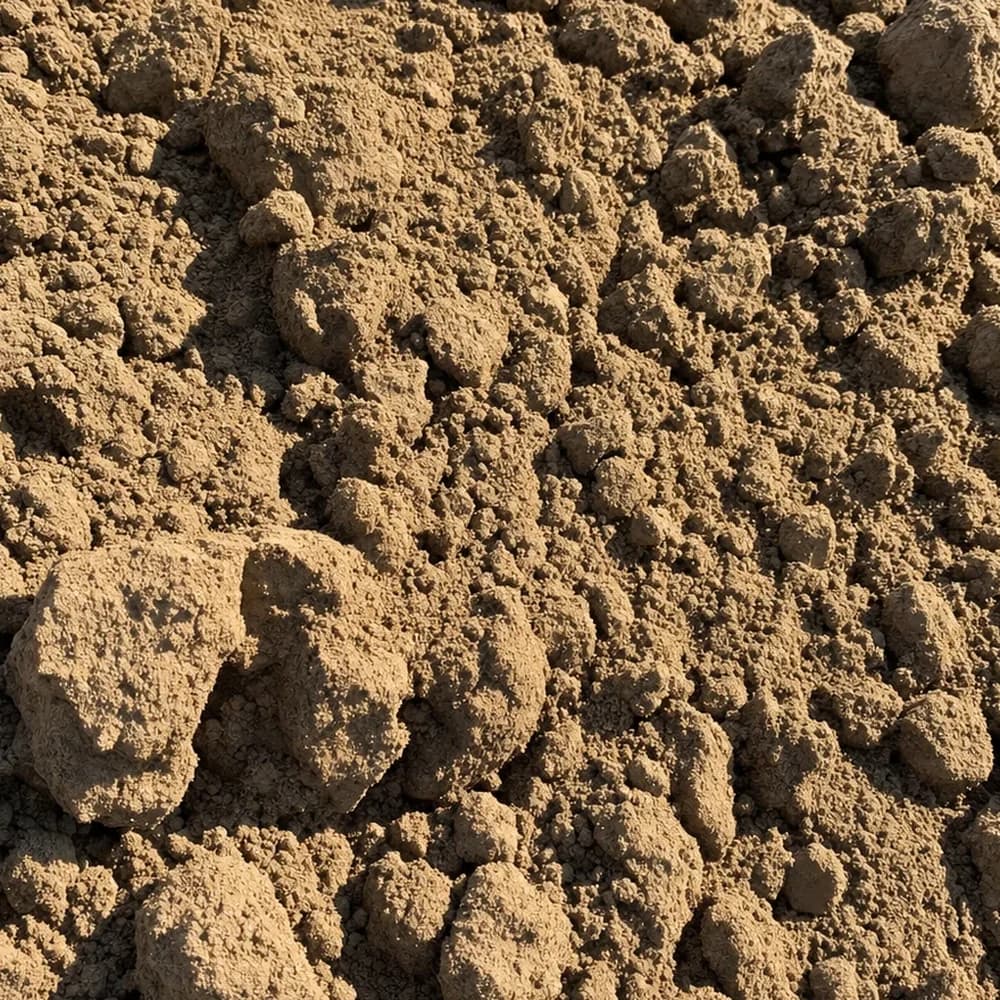
Fill dirt is screened mineral subsoil with the organic matter and debris taken out, which is exactly why it holds a grade instead of rotting down and dropping. It belongs under things: raised grade, backfill, berms and holes. It is not a growing layer.
Use this page for that structural bulk. Use the topsoil calculator for the 4 to 6 inches of screened top soil that goes over the fill before seed or sod. Use the soil calculator for garden soil in raised beds and planting holes, where a blended mix at about 2,000 lb per yard is the lighter material. Build a low lawn area in that order and stop the fill 4 to 6 inches below the finished grade so the growing layer has somewhere to go.
Ordering Once Rather Than Twice
Consolidation is what brings people back for a second half load, and the 10 percent box does not cover it on its own. Place fill dirt in 6 to 8 inch lifts and compact each one, or at the very least soak each lift and let it settle before the next. Keep organic debris out of the fill entirely. Round the yardage up to the next half yard, and put the leftover into the ruts that show up after the next storm.
When the number looks right, set the quantity and a date on the product page. Delivery is arranged at checkout by ZIP code and the truck needs clear access to the dump spot, so pick a firm spot near the hole rather than a tidy one near the house. If the depth of a washout will not settle down to one honest figure, send the readings through the contact page before ordering.
Common questions
Why does the same 6 inches need different tonnage for fill than for topsoil?
Because a cubic yard of each weighs a different amount. Six inches over a 20 by 20 ft area is 200 cu ft either way, which is 7.41 yd3. As fill dirt at 1.20 that is 8.9 tons; as screened topsoil at 1.10 it is 8.2. The volume is what the ground asks for, and the weight follows the material.
Is the 10 percent option enough for settling?
Not by itself. Loose fill consolidates by something closer to 10 to 15 percent, so treat the box as spillage cover and handle the rest by compacting in lifts and finishing lawn repairs a touch above grade.
The low ground runs down a slope. What depth do I enter?
Depth on a slope is a wedge, not a slab. Measure how far the surface needs to rise at the top of the fill and at the bottom, then enter the average of the two. If the shallow end is nearly nothing, measure the fill area only where dirt is actually going.
My washout wraps around the corner of the drive. Can I do it in one calculation?
Yes. Multiple areas takes up to five rectangles, and each one carries its own depth, which suits a washout that is deep along one leg and shallow along the other. Split them at the corner so they do not overlap.
Where does the fill area stop against the lawn?
To where the fill stops. If you are feathering the new grade into the lawn, include the feathered strip at a small average depth of an inch or two rather than at the full depth, otherwise the estimate runs high.
Related calculators
Cheap by the yard, free to your gate.
Screened fill dirt for grading and backfill, delivered across Missouri.