Topsoil Calculator: What the Bare Yard Actually Takes
Enter your project dimensions
Stand in the yard and look at what is there. Scraped subsoil left by a builder, a rutted patch where a truck turned, chert showing through thin Ozark ground, or a lawn that is simply lumpy and needs half an inch worked across it. Those four yards want wildly different orders, and on this page the difference is almost never the square footage. It is the depth. The topsoil calculator does the arithmetic once you have decided which of those jobs you are actually doing.
How Do I Measure a Lawn That Wraps Around the House?
In pieces. Front, side and back are three rectangles, and the tool takes up to five areas and adds them into one total. Measure each one to where the soil stops rather than to the fence, take the length and width in feet, and leave out the drive, the patio and any bed that is not getting topsoil.
For a side strip that narrows as it runs, measure the width at each end and use the average. For a curved back boundary, fit rectangles inside the shape so they do not overlap, then add a little for the leftover corners. A round feature such as an island bed goes in under circle mode as the distance straight across.
How Deep Does Seed Need Over Chert and Clay?
| Job | Depth |
|---|---|
| Topdressing an established lawn | 1/4 to 1/2 inch |
| Preparing to overseed | 1/2 to 1 inch |
| New lawn from seed or sod | 4 to 6 inches over loosened subgrade |
| New flower bed blended into the soil below | 6 inches |
Loosen the surface underneath by at least an inch before the topsoil goes on, whatever the depth. Four inches of good soil sitting on compacted clay behaves like a plugged basin: water reaches the join and stops. Take the deeper end of the range over northern claypan, which perches water from late autumn into spring, and over thin cherty ground where there is little to loosen. Shape the finished grade to fall away from the house, roughly six inches over the first ten feet.
How Many Yards Does a 1,150 Square Foot Lawn Take?
Hypothetical sizes, not customer jobs.
New lawn, seed or sod, 1,150 square feet at four inches.
- 1,150 x 4 / 12 = 383.3 cu ft
- 383.3 / 27 = 14.20 cu yd, which at 1.10 is about 15.6 tons
Topdressing 2,900 square feet of established lawn at half an inch.
- 2,900 x 0.5 / 12 = 120.8 cu ft
- 120.8 / 27 = 4.48 cu yd, or 4.9 tons
An L-shaped side yard, 34 by 12 feet plus 16 by 9 feet, at four inches.
- 408 + 144 = 552 sq ft, so 552 x 4 / 12 = 184 cu ft
- 184 / 27 = 6.81 cu yd, or 7.5 tons
One yard covers 648 square feet at a half-inch topdressing, 162 at two inches, 81 at four and 54 at six. That spread is the whole reason to settle the depth before the tape comes out.
What Does a Yard of Screened Topsoil Weigh?
About 2,200 pounds, which is 1.10 tons to the cubic yard, and that is the figure the tool applies. Cubic yards come from the area in square feet times the depth in inches divided by 12, all divided by 27; tons follow from the weight.
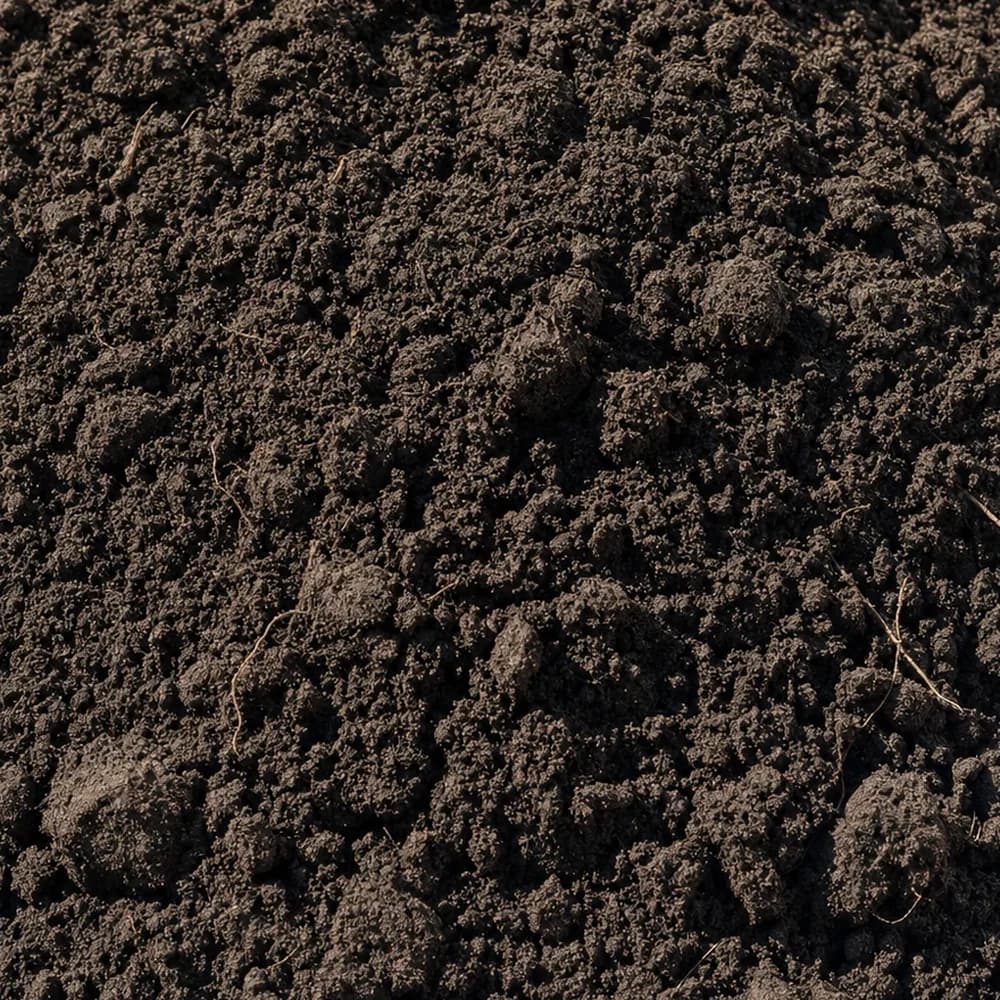
Read the cubic yards line first, because topsoil is sold by volume. Rain changes what a shovelful weighs without changing how far the pile goes, so a wet load covers the same ground as a dry one and simply works harder. Screened material has had the rocks, roots and clods taken out of it, which on Missouri ground means noticeably less raking behind the wheelbarrow. A good load is dark and loose, smells of earth rather than anything sour, and a damp handful squeezed in the fist should hold a soft ball that falls apart when you touch it. A smooth ribbon means clay; gray color or a sour smell means it has been stored wet.
Do I Need the Five Percent Box for a Lawn?
The form has a rectangle, circle and multiple-areas mode, length, width and diameter in feet, depth in inches from 0.25 to 24, a material list and an optional tick box that adds five percent for compaction and spillage. Outputs are cubic yards, tons and cubic feet, and an email field will send them on.
For a new lawn, tick it. Between the soil that disappears into a loosened subgrade and the wheelbarrow spillage across a big area, five percent gets used up quickly. For a half-inch topdressing it makes almost no difference and you can untick it. What the box will not do is rescue a depth you guessed low, so if the choice is between five percent and an extra half yard on a lawn you only want to seed once, take the half yard.
Is This Topsoil, Garden Soil or Fill Dirt?
Three products and three tools, and the answer is what the material has to do.
Top Soil, screened, is what this page sizes: lawns, finish grading, leveling and patching. Planting beds and raised boxes want compost already blended in, which is Garden Soil on the soil calculator. Raising a grade, filling a washout or backfilling is structural work for Fill Dirt, sized on the dirt calculator, which allows for the way loose fill consolidates. On a yard that needs building up before it needs seeding, put the fill in first and stop it four to six inches below the finished grade so there is room for the growing layer.
Topsoil goes over grass only as a thin topdressing of up to half an inch, with the grass tips left showing. Anything more than an inch means stripping or killing the turf first, since sod buried under new soil rots unevenly and leaves the lawn lumpy for a season. Arrange delivery for the week you intend to spread. Delivery is set at checkout by ZIP code and the truck needs clear access to a dump spot, so pick somewhere firm and close to the work, and the delivery page covers how that is handled. If the job turns out to be stone, mulch or fill rather than soil, all the calculators sit on one hub.
Common questions
Can I total the front and back lawns in one calculation?
Yes. Multiple areas holds up to five rectangles and adds them together, and each one keeps its own depth, which suits a back lawn going down at four inches while the front only needs a topdressing pass. Keep the pieces from overlapping where they meet at the corner of the house.
Does the strip under the edging go into my area?
Only if soil is going on it. Measure to the inside of a bed edge or a mowing strip when the topsoil stops there. Where you are feathering a repair out into existing lawn, include the feathered strip but enter it at an inch or two rather than the full depth, or the estimate runs high.
I need fill underneath and topsoil on top. How do I order both?
As two runs over the same footprint. Size the fill to bring the ground up to within four to six inches of finished grade, then size the topsoil for those last inches. Order them together if the yard is ready, and get the fill compacted in lifts before the growing layer goes on.
My back lawn has a curved boundary and a tree in the middle of it. What do I enter?
Fit two or three rectangles inside the curve without overlapping, enter them under multiple areas, and work out the tree ring as its own small calculation to subtract. A 12-foot ring around a trunk is 113 square feet, which at four inches is 1.4 cubic yards you are not spreading.
The lawn is mostly fine and just low in patches. How do I measure that?
Lay a straight board across each hollow, measure down to the ground at the deepest point and at the edges, and average them. Then measure the footprint of the hollow itself rather than the whole lawn. Three patches averaging 40 square feet each at two inches come to 20 cubic feet, which is 0.74 cubic yards, under a ton.
Related calculators
Lawn math done? Soil's on us to deliver.
Screened topsoil by the cubic yard, free delivery across Missouri.