Rip Rap Calculator: Tons of Armor Stone for a Bank
Enter your project dimensions
Rip rap gets mistaken for landscape rock, and the mistake is expensive in both directions. Decorative stone goes into a bed two or three inches deep and its job is to look right. Armor stone goes onto a creek bank or a pond dam at twelve inches or more, and its job is to still be there after the next storm sends water down an Ozark hollow. That difference in depth is roughly a sixfold difference in tonnage over the same square footage, which is why the rip rap calculator is a separate tool. Start with a worked job.
Twenty-Four and a Half Tons for a 2:1 Creek Bank
Invented dimensions for the sake of the arithmetic, not a customer project.
A bank has been cut back to a 2:1 slope, the face measures 9 ft from the toe up to the top, and the stretch being armored runs 45 ft along the creek. Stone in the 6 to 8 inch range calls for a layer of about 12 inches.
- 45 x 9 = 405 sq ft of slope face
- 405 x 12 / 12 = 405 cu ft
- 405 / 27 = 15.0 yd3
- 15.0 x 1.55 = 23.3 tons, or 24.4 with the 5 percent box. Order 24.5.
The stone cannot sit straight on soil. Under it goes non-woven geotextile, which comes from a landscape supplier rather than this catalogue, or a bedding course of 3 to 4 inches of #4 stone, which for the same face at 4 inches is 135 cu ft, 5.0 yd3 and 7.3 tons at 1.45. Put both on one order so the bedding is on site before the armor stone lands on top of it.
For comparison, the apron below an 18 inch culvert carried 9 ft downstream, at 8 ft wide and an 18 inch layer, works out at 72 sq ft, 108 cu ft, 4.0 yd3 and 6.2 tons. Small jobs and big ones run on the same arithmetic.
Lay the Tape Up the Bank Before You Touch the Form
The single measurement that decides whether the order is right is the one taken up the slope. A bank that rises 4 ft over an 8 ft run has a face close to 9 ft, and entering 8 leaves the job nearly ten percent short before anything else goes wrong. Lay the tape on the bank and read what it says.
The form takes a rectangle, a circle, or up to five areas totaled together, which suits a bank in three stretches of different steepness. Length and width go in as feet, so enter the along-the-water length as one and the slope face as the other. Depth goes in as inches and takes 0.25 to 24, which is the layer thickness. Pick the material, tick the optional 5 percent for compaction and spillage, and calculate for cubic yards, tons and cubic feet. A layer thicker than 24 inches has to go in as two passes over the same footprint and the results added.
Layer thickness is a function of stone size: one and a half to two times the largest rock, with 12 inches as the practical floor for erosion control. Typical 4 to 12 inch stone wants 12 to 18 inches, and larger rock or faster water wants 24.
One Ton Covers a Patch of Bank 4 Feet Square
Cubic yards are slope-face area in square feet times layer thickness in inches divided by 12, all divided by 27. Tons are those yards times 1.55, the heaviest figure on this site.
| Layer thickness | One ton covers | Tons per 100 sq ft |
|---|---|---|
| 12 inches | about 17 sq ft | 5.7 |
| 18 inches | about 12 sq ft | 8.6 |
| 24 inches | about 9 sq ft | 11.5 |
A ton is about two thirds of a cubic yard, which looks unconvincing in a pile and covers a patch of bank roughly 4 ft square at the standard layer. Both output figures matter here more than on any other page: tons are what you order and what the truck is loaded to, and the cubic yard figure tells you how much ground the pile will take up beside the water, which is the number to check before the load arrives.
The Toe Is Where a Short Order Shows
Rip rap fails from the bottom. Set the lowest row below the waterline or below the depth water is likely to scour to, then work up the face, keying the exposed stones together rather than tipping them and letting them lie where they land.
Before that lowest row goes in below the ordinary high water line of a creek, river or pond, find out what approval your state and local authorities require. Putting rock in and along a watercourse is commonly permitted work, what is required depends on the waterbody, and a tonnage page cannot answer it. A job that runs out of stone halfway along ends up with a thin toe over the last stretch, and that stretch is where the next high water starts.
So round up, and round up at the toe end rather than the top. Where a culvert discharges, carry the apron four to six pipe diameters downstream, since that is where the scour hole forms. After the first big storm, walk the bank once the water drops: look for stone that has shifted, soil showing between rocks and fabric showing through, and put the spare stone into those spots. Twice a year is enough after that.
Armor Stone, Bedding Stone and the Decorative Kind
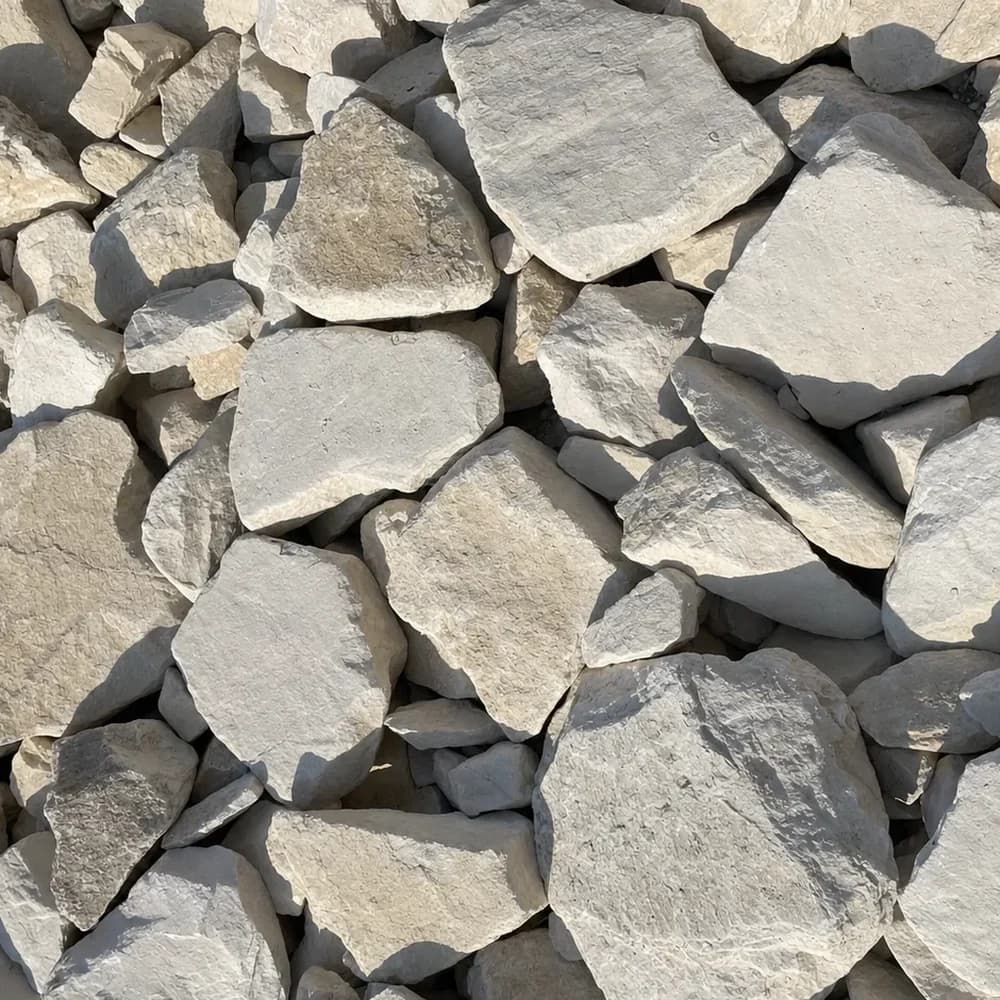
RipRap is the armor stone this page calculates, in sizes that commonly run from 4 to 12 inches and larger. Four to eight inch stone suits pond banks, downspout outfalls and quiet creeks. Eight to twelve is for lake edges taking boat wake and for faster channels. Highway and spillway work carries its own classes and layer depths on the drawing, so follow that rather than this page.
Under it goes #4 Crushed Stone as the bedding course, sized on the stone calculator at 1.45 tons per yard. What does not belong on a bank under moving water is decorative stone: river rock and large river rock are figured on the river rock calculator at 1.35 tons per yard and belong in beds and dry creek runs where water only passes through after a storm.
Slopes steeper than 2:1 want engineering rather than extra stone; if you cannot tell which side of that line your bank falls on, the contact page is the place to ask before ordering. With the tonnage settled, set a quantity and a delivery date on the product page. Delivery is arranged at checkout by ZIP code and the truck needs firm, clear access to the dump spot.
Common questions
What actually happens if I order a few tons short?
You end up spreading the layer thinner than planned, usually at the last section worked, and a thin layer is not a small problem on a bank. Water gets under stone that is not keyed in, takes the soil out from beneath it and drops the whole run. It is cheaper to have a couple of tons left over for the outfall than to rebuild a section next spring.
My 45 ft stretch came out at 23.3 tons. How far can hand-placed stone drift from that?
The arithmetic is exact; the bank is not. Armor stone is placed, not poured, and how tightly stones key together varies, as does how even the face is once it is cut back. Treat the figure as solid to within a few percent, measure the face carefully, and keep the rounding on your side.
Does the bedding course go on the same order as the armor stone?
The RipRap page for the armor stone, at the size class that matches your water, and the #4 Crushed Stone page for the bedding course if you are not using geotextile. Both go on one order, with the bedding scheduled to arrive first.
How close to the creek bottom can a loaded truck get to drop the stone?
Somewhere firm, above the wet ground and as close to the bank as a loaded truck can safely reach. The last stretch of ground next to a pond edge or a creek bottom will bog a truck down, and moving the same stone twice is the most avoidable cost on the job. Walk the route before you order.
What is the 15 cubic yards figure for if the stone is sold by the ton?
Rip rap is ordered by the ton, so that is the figure to use. The cubic yard number describes the same stone as a volume, which is the one you need for planning the drop: 15 yards is a pile you have to find room for before it arrives.
Related calculators
Banks don't armor themselves.
RipRap by the ton with free delivery, plus the #4 bedding stone to go under it.